    /\
   /  \       _____ _____ _______ ______ __  __ _____ _____   _____ _____
  / /\ \     |  _  |  _  |__   __|  ____|  \/  |_   _/ ____| |_   _|_   _|
 / /__\ \    | |_| | |_| |  | |  | |__  | \  / | | || (___     | |   | |
/________\   |  _  |    _/  | |  |  __| | |\/| | | | \___ \    | |   | |
|   ||   |   | | | | |\ \   | |  | |____| |  | |_| |____) |  _| |_ _| |_
|___||___|   |_| |_|_| \_\  |_|  |______|_|  |_|_____|_____/ |_____|_____|_
Artemis Mission Tracker — Artemis II Archive & Artemis III Countdown
Crew safely home · first crewed lunar flyby since 1972 · Apr 1–10, 2026 · 9 d 1 h 32 m mission archive
🌑 Next up: track Artemis III — NASA's 2027 crew, countdown, and the low-Earth-orbit Human Landing System docking plan. →Sources: NASA splashdown release · Flight Day 6 flyby log · Flight Day 7 log · NASA initial assessments (Apr 20). Total distance: NASA has quoted both 694,481 and 695,081 miles.


Beyond Earth's magnetosphere, the Artemis II crew was exposed to solar radiation. Solar flares and coronal mass ejections (CMEs) can produce dangerous radiation bursts, so space weather was monitored around the clock during the mission, and sensors — including the German Space Agency's M-42 detectors — measured radiation at different shielding locations inside Orion. The feed below shows current solar activity.
Heat shield: After Artemis I came home with unexpected char loss in its AVCOAT heat shield, NASA kept the same design for Artemis II but flew a steeper, non-skip entry. NASA's April 20 assessment reported the Artemis I char-loss behaviour was significantly reduced, in both quantity and size; NASASpaceflight later reported nine spallation sites versus more than 100 on Artemis I. Entry velocity came within one mile per hour of prediction, and Orion splashed down 2.9 miles from its target.
Open item: the one issue NASA singled out for root-cause work before Artemis III was a urine vent line problem linked to the toilet fault the crew handled on the first day.
Honours: On August 28, 2026, President Trump presented Wiseman, Glover, Koch and Hansen with the Congressional Space Medal of Honor at NASA's Johnson Space Center. In late September NASA announced that Glover and Wiseman are moving to emeritus status, staying on to train and mentor.
What's next: On June 9, 2026 NASA named the Artemis III crew — Randy Bresnik (commander), Luca Parmitano (pilot, ESA), Andre Douglas and Frank Rubio. Rather than landing, Artemis III (2027) will rendezvous and dock with test versions of the SpaceX and/or Blue Origin landers in low Earth orbit. The first crewed landing is now planned for Artemis IV in 2028. Follow it on the Artemis III tracker.
After nearly 10 days in space and a historic lunar flyby, the Artemis II crew is safely home. At 7:33 p.m. EDT, crew and service module separated — the service module burning up harmlessly over the Pacific while the crew module continued toward Earth.
At 7:53 p.m., Orion hit the atmosphere at 400,000 feet, travelling 35 times the speed of sound — still 1,956 miles from the splashdown site. A planned six-minute communications blackout followed as superheated plasma engulfed the capsule. Contact was reestablished at 8:00 p.m.
Splashdown came just 2.9 miles from the target point, and by 8:12 p.m. recovery teams in inflatable boats were approaching Orion. Navy divers attached a winch line to tow the capsule into USS John P. Murtha's well deck cradle. At 9:34 p.m., all four crew members — Wiseman, Glover, Koch, and Hansen — were extracted from the capsule. By 9:56 p.m. they were hoisted into military helicopters, and at 9:58 p.m. safely aboard the Murtha for post-mission medical evaluations before transport to Johnson Space Center in Houston.
Orion was secured in the ship’s well deck at 4:27 a.m. EDT the next morning and then shipped from Naval Base San Diego back to Kennedy Space Center in Florida for post-flight inspection.
At 2:53 p.m. EDT, Orion performed its final thruster burn — lasting just 8 seconds and producing a velocity change of 4.2 feet per second — to lock in the trajectory for Earth return. The crew of Reid Wiseman, Victor Glover, Christina Koch, and CSA astronaut Jeremy Hansen then completed procedures review, monitored spacecraft configuration, and analyzed navigation data.
With cabin preparations for re-entry progressing through final entry checklists, the crew is now on course for splashdown at 8:07 p.m. EDT (5:07 p.m. PDT) off the coast of San Diego. Recovery vessel USS John P. Murtha is standing by.
Live return coverage began at 6:30 p.m. EDT across NASA+, Amazon Prime, Apple TV, Netflix, HBO Max, Discovery+, Peacock, and Roku — continuing through crew extraction and transport. After 10 days in space and a historic lunar flyby, Artemis II is coming home.
The crew's final full day in space. At wake-up, Orion was 147,337 miles from Earth, closing fast. The morning began with a Charley Crockett song before the crew turned to return preparations.
Mission Specialists Koch and Hansen spent the day stowing equipment and securing cargo, while all four crew members reviewed the weather briefing, recovery status, and entry procedures. A second trajectory correction burn is scheduled for 9:53 p.m. EDT, with Hansen monitoring guidance, navigation, and propulsion systems during the maneuver.
Splashdown remains on target for 8:07 p.m. EDT on April 10 off the San Diego coast. During re-entry, Orion will reach approximately 23,864 mph and experience a planned six-minute communications blackout as plasma forms around the capsule. The crew will endure up to 3.9 Gs during descent. Recovery helicopters will extract the crew and transport them to USS John P. Murtha for post-mission medical evaluations. Live coverage begins at 6:30 p.m. EDT on NASA+, Netflix, and YouTube.
At wakeup, the crew was approximately 200,278 miles from Earth and 83,549 miles from the Moon, journeying homeward after their historic lunar flyby.
All four crew members — Commander Reid Wiseman, Pilot Victor Glover, Mission Specialist Christina Koch, and CSA astronaut Jeremy Hansen — tested a specialized orthostatic intolerance compression garment worn under their spacesuits. The equipment helps astronauts maintain proper blood pressure and circulation during re-entry, countering dizziness after extended weightlessness. The crew also completed their daily flywheel exercise routine for aerobic and resistance fitness in microgravity.
At 10:45 p.m. EDT the crew held a news conference to discuss their lunar experiences. NASA is targeting splashdown at 8:07 p.m. EDT on April 10, 2026, off the San Diego coast, with live coverage on NASA+, Netflix, and YouTube.
Following the historic lunar flyby on April 6, the crew awakened positioned 236,022 miles from Earth and 36,286 miles from the Moon, beginning the journey home; Orion left the Moon’s sphere of influence at 1:25 p.m. EDT. The crew captured stunning photographs during the flyby, including an Earthset image and a view of the Moon blocking the Sun for nearly 54 minutes — far longer than any eclipse visible from Earth's surface.
At 2:40 p.m. EDT, the crew held a 15-minute ship-to-ship call with astronauts aboard the International Space Station to share their lunar experiences. At 3:00 p.m., a science debrief with ground teams captured lunar observations while the flyby was still fresh.
At 8:03 p.m. EDT, Orion Integrity ignited its thrusters for 15 seconds, achieving a velocity change of 1.6 feet-per-second — the first of three return correction burns. Mission Specialists Christina Koch and Jeremy Hansen monitored spacecraft systems during the maneuver. Mission officials confirmed the USS John P. Murtha has departed port and is heading toward the Pacific Ocean recovery site.
Orion completed its historic close flyby of the Moon, passing within 4,067 miles (6,545 km) of the lunar surface at 7:00 p.m. EDT. The crew spent a seven-hour observation period studying 30 lunar surface targets including the Orientale basin (a 3.8-billion-year-old impact basin nearly 600 miles wide), the roughly 400-mile-wide Hertzsprung basin on the far side, the bright swirl Reiner Gamma and Glushko crater. In total the crew captured more than 7,000 images of the lunar surface.
At 1:56 p.m. EDT, Orion broke the all-time record for farthest distance traveled by humans from Earth, surpassing Apollo 13's 1970 record of 248,655 miles and at 7:02 p.m. — two minutes after closest approach — Orion reached its maximum distance of 252,756 miles (406,771 km), about 4,100 miles beyond Apollo 13. At closest approach, Orion was moving just 3,139 mph relative to the Moon.
At 6:41 p.m. EDT, the crew witnessed Earthset — Earth dropping below the lunar horizon. A planned ~40-minute communications blackout followed (6:44–7:25 p.m.) as Orion passed behind the Moon's far side — the first time crewed humans had been beyond all communication with Earth since Apollo 17 in 1972. Signal was reacquired at 7:24 p.m. alongside a view of Earthrise. A solar eclipse phase began at 8:35 p.m. for approximately one hour.
During the flyby the crew proposed names for two unnamed craters, to be submitted to the International Astronomical Union: Integrity crater (named after the Orion spacecraft) and Carroll crater (honouring Commander Reid Wiseman's late wife, Carroll Taylor Wiseman, who died in 2020).
"As we prepare to go out of radio communication, we're still going to feel your love from Earth. And to all of you down there on Earth and around Earth, we love you, from the Moon. We will see you on the other side."— Pilot Victor Glover, before far-side blackout
"As we surpass the furthest distance humans have ever traveled from planet Earth, we do so in honoring the extraordinary efforts and feats of our predecessors in human space exploration."— CSA astronaut Jeremy Hansen, as the record fell
The crew spent Day 5 putting the Orion Crew Survival System (OCSS) suits through a full workout — donning and pressurisation, leak checks, seat entry simulation, and mobility assessments including eating and drinking in a pressurised suit. The suits are designed to keep the crew alive in cabin depressurisation and after splashdown.
At 11:03 p.m. EDT a 17.5-second outbound trajectory correction burn fired to refine Orion's path toward the Moon — placing the spacecraft precisely on track for Monday's flyby. Mission control had already cancelled an earlier planned burn after confirming the trajectory was optimal. The crew entered sleep at 2:20 a.m., scheduled to wake at 10:50 a.m. for the most significant day of the mission.
Science teams transmitted the final list of 30 lunar surface targets for the crew to observe during the roughly seven-hour observation window, including the Orientale and Hertzsprung basins on the far side.
The crew woke to Chappell Roan's "Pink Pony Club" with Orion sitting 169,000 miles from Earth and closing on the Moon. The headline event came at 9:09 p.m. EDT when Mission Specialists Christina Koch and Jeremy Hansen took manual control of Orion in deep space — a 41-minute demonstration testing both six-degree and three-degree thruster modes. A repeat by Commander Wiseman and Pilot Glover was planned for Flight Day 8 (April 8) on the return leg, but flight controllers later elected to forgo it.
A second planned outbound trajectory correction burn was cancelled — Orion was already on the ideal path. An optical communications milestone was reached: the O2O laser terminal passed 100 gigabytes of data downlinked. The crew also reviewed lunar imaging targets, and NASA released a high-resolution Orion “selfie” taken by a solar array wing camera during an external inspection on Flight Day 2.
Science payloads active on Day 4 included AVATAR (bone marrow cells studying immune response in deep space), M-42 German radiation sensors, and actigraphy health monitoring devices. The crew collected saliva samples for biomarker analysis.
Flight controllers at NASA's Johnson Space Center elected to cancel the first outbound trajectory correction burn — Orion's trajectory was so precise after the TLI burn that no adjustment was needed. Commander Wiseman photographed Earth from Orion's main window as the spacecraft continued coasting toward the Moon. Any necessary fine-tuning would be incorporated into subsequent correction burns.
With the spacecraft in excellent health and the crew beginning to adapt to their deep-space environment, attention turned to reviewing the 30 lunar surface observation targets the science team had prepared for the April 6 flyby.
↗ Read full update on nasa.govAt 7:49 p.m. EDT, Orion's engine fired for 5 minutes 50 seconds, consuming ~1,000 lbs of fuel at 6,700 lbs of thrust to break free of Earth's gravity and set a figure-eight trajectory toward the Moon. That thrust is enough to accelerate a car from 0 to 60 mph in about 2.7 seconds. Orion's mass at the burn was 58,000 lbs.
Between orbital checkouts, the crew exercised on the flywheel resistance device (a 30-lb, carry-on-suitcase-sized unit offering up to 400 lbs of resistance), completed checkout of the AVATAR scientific payload, and took part in a media downlink answering questions from reporters. A brief two-way communications loss was quickly resolved — a ground configuration issue with the TDRS relay satellite, no mission impact.
↗ Read full update on nasa.govAhead of the apogee raise burn on April 1, the crew reported a blinking fault light on Orion's Universal Waste Management System. The crew worked closely with mission control in Houston to assess and resolve the issue, successfully restoring the toilet to normal operations. No impact to mission objectives. In its April 20 post-flight assessment, NASA named a urine vent line problem as the item to root-cause and correct before Artemis III.
↗ Read full update on nasa.govAt 6:35 p.m. EDT, SLS lifted off from Launch Complex 39B at Kennedy Space Center with 8.8 million pounds of thrust from its twin solid rocket boosters and four RS-25 engines — the most powerful rocket ever to carry humans. The weather forecast improved from 80% to 90% go, and engineers cleared a flight termination system communication issue and a launch abort system sensor reading (traced to instrumentation). An extended T-10 minute hold moved liftoff from the 6:24 p.m. window opening to 6:35 p.m.
The launch day tradition held: at 2:00 p.m. the crew completed a card game — commander must lose to clear bad luck. At 2:14 p.m. the crew walked to the pad; at 2:31 p.m. they boarded Orion and began comms checks. Launch Director issued a unanimous "go/no-go" poll at 6:22 p.m. The mission is expected to last approximately 10 days.
↗ Read full launch day updates on nasa.govThe crew successfully completed the proximity operations demonstration in approximately 70 minutes, testing manual spacecraft maneuvering capabilities around the Interim Cryogenic Propulsion Stage (ICPS). Validated Orion's manual control systems in space for the first crewed flight.
↗ Read full update on nasa.govThe apogee raise burn completed successfully via the ICPS RL10 engine, sending Orion into a high Earth orbit with an apogee of about 44,000 miles (70,000 km) and a 23.5-hour period, ahead of proximity operations and the trans-lunar injection burn.
↗ Read full update on nasa.govThe perigee raise maneuver completed successfully. The spacecraft experienced a brief planned loss of communications following the burn as Orion passed through a comms gap. All systems nominal.
↗ Read full update on nasa.govThe four Artemis II astronauts arrived at Kennedy Space Center on March 27 and revealed their zero-gravity indicator, “Rise” — a plush Moon wearing Earth as a baseball cap, designed by eight-year-old Lucas Ye of Mountain View, California, and picked from more than 2,600 entries. A floating plush toy is a long-standing spaceflight tradition for showing the crew has reached weightlessness.
↗ Read full update on nasa.gov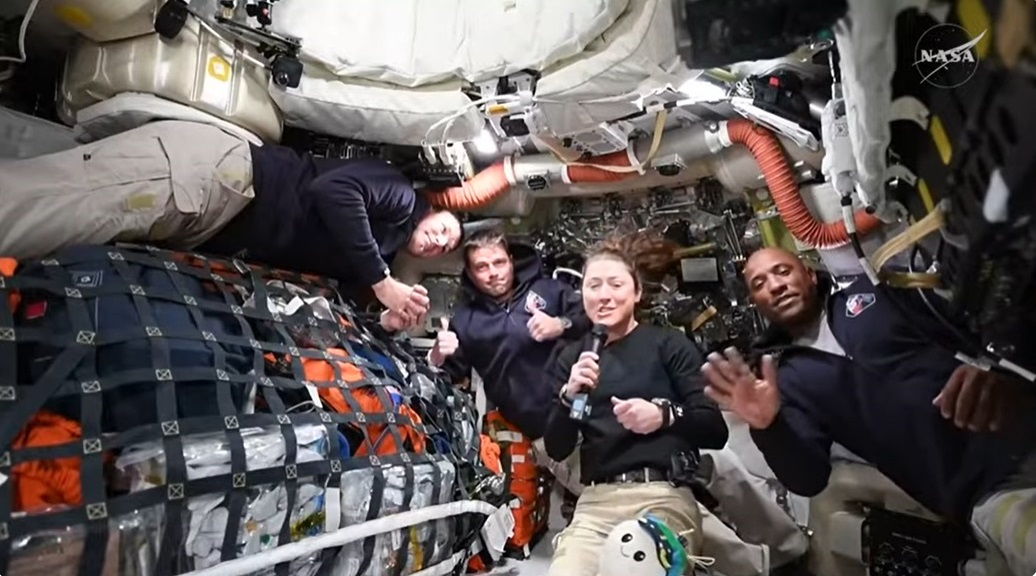
Guide — relive Artemis II in five steps
The verified NASA results: 252,756 miles from Earth, a human record, and 4,067 miles above the lunar far side at closest approach.
The trajectory chart draws the free-return path: out to the Moon, around the far side, and back to Earth on lunar gravity.
Reid Wiseman, Victor Glover, Christina Koch and Jeremy Hansen — their roles, backgrounds and the firsts they set.
Launch on April 1, the trans-lunar burn on April 2, the far-side flyby on April 6 and splashdown off San Diego on April 10.
Artemis III (2027) tests docking with commercial landers in Earth orbit; the first crewed landing is now planned for Artemis IV.
What each part of the page answers
- farthest
- 252,756 mi / 406,771 km from Earth
- beat
- Apollo 13’s 248,655 mi (1970)
- shape
- free-return figure-eight
- flyby
- April 6, over the far side
- NASA
- Wiseman, Glover, Koch
- CSA
- Hansen, first Canadian to the Moon
- Artemis III
- 2027, docking test in Earth orbit
- Artemis IV
- first crewed landing, planned 2028
Artemis II is NASA's first crewed mission to the Moon since Apollo 17 in 1972. The mission launched on April 1, 2026 at 6:35 p.m. EDT from Launch Complex 39B at Kennedy Space Center, Florida. Four astronauts flew around the Moon on a figure-eight free-return trajectory, coming within 4,067 miles (6,545 km) of the lunar surface, and splashed down in the Pacific off San Diego on April 10 at 8:07 p.m. EDT — 9 days, 1 hour and 32 minutes after liftoff. It was a critical test flight to validate Orion’s crewed systems in deep space before NASA attempts a landing, now planned for Artemis IV in 2028.
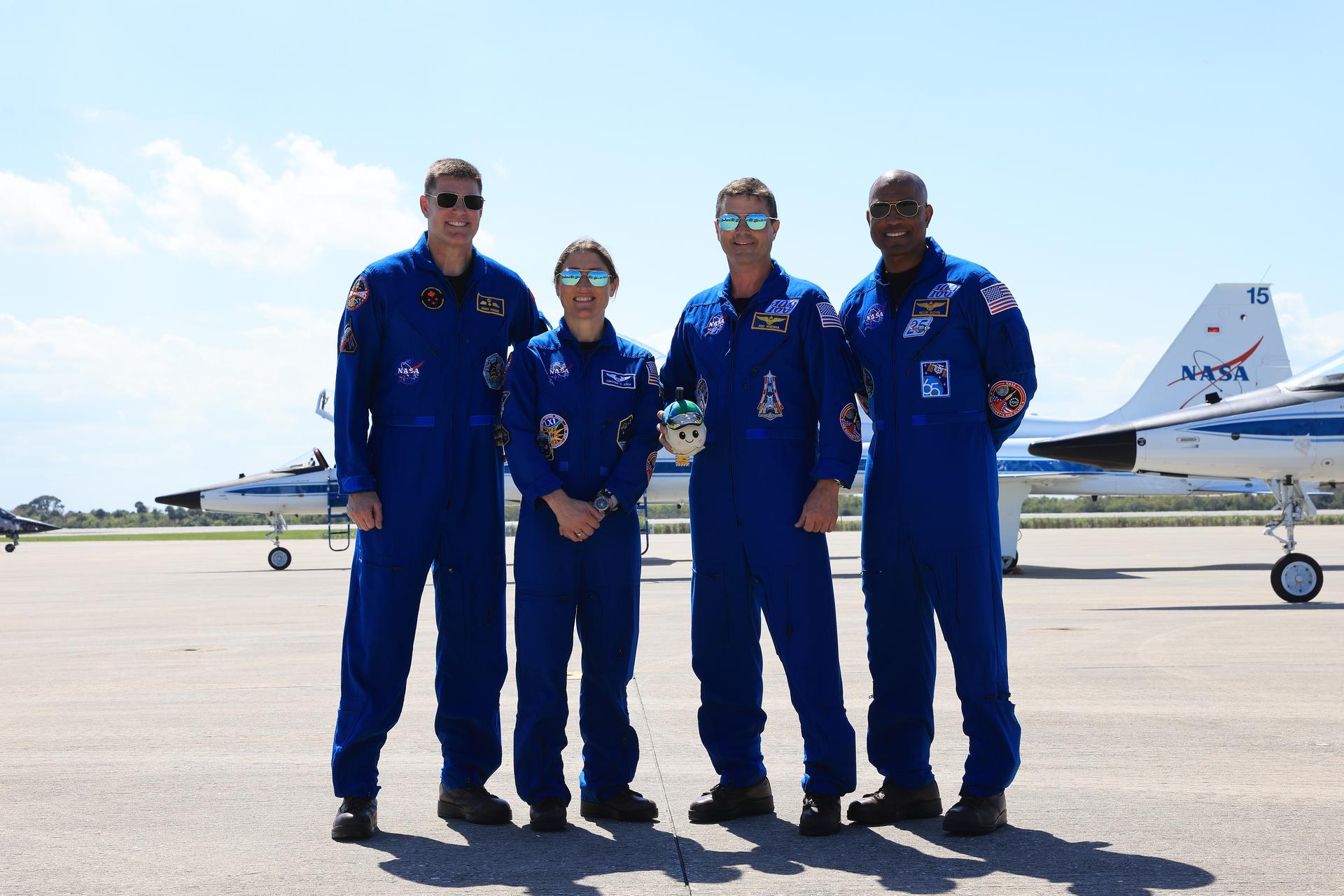
The four-person crew consists of Commander Reid Wiseman (NASA), Pilot Victor Glover (NASA), Mission Specialist Christina Koch (NASA), and Mission Specialist Jeremy Hansen (Canadian Space Agency). This crew made history: Victor Glover became the first person of color to travel beyond low Earth orbit, Christina Koch the first woman, Jeremy Hansen the first Canadian and first non-American to fly beyond low Earth orbit, and Reid Wiseman the oldest person ever to leave low Earth orbit. With four people aboard, it was also the largest crew ever sent into deep space — one more than any Apollo mission.
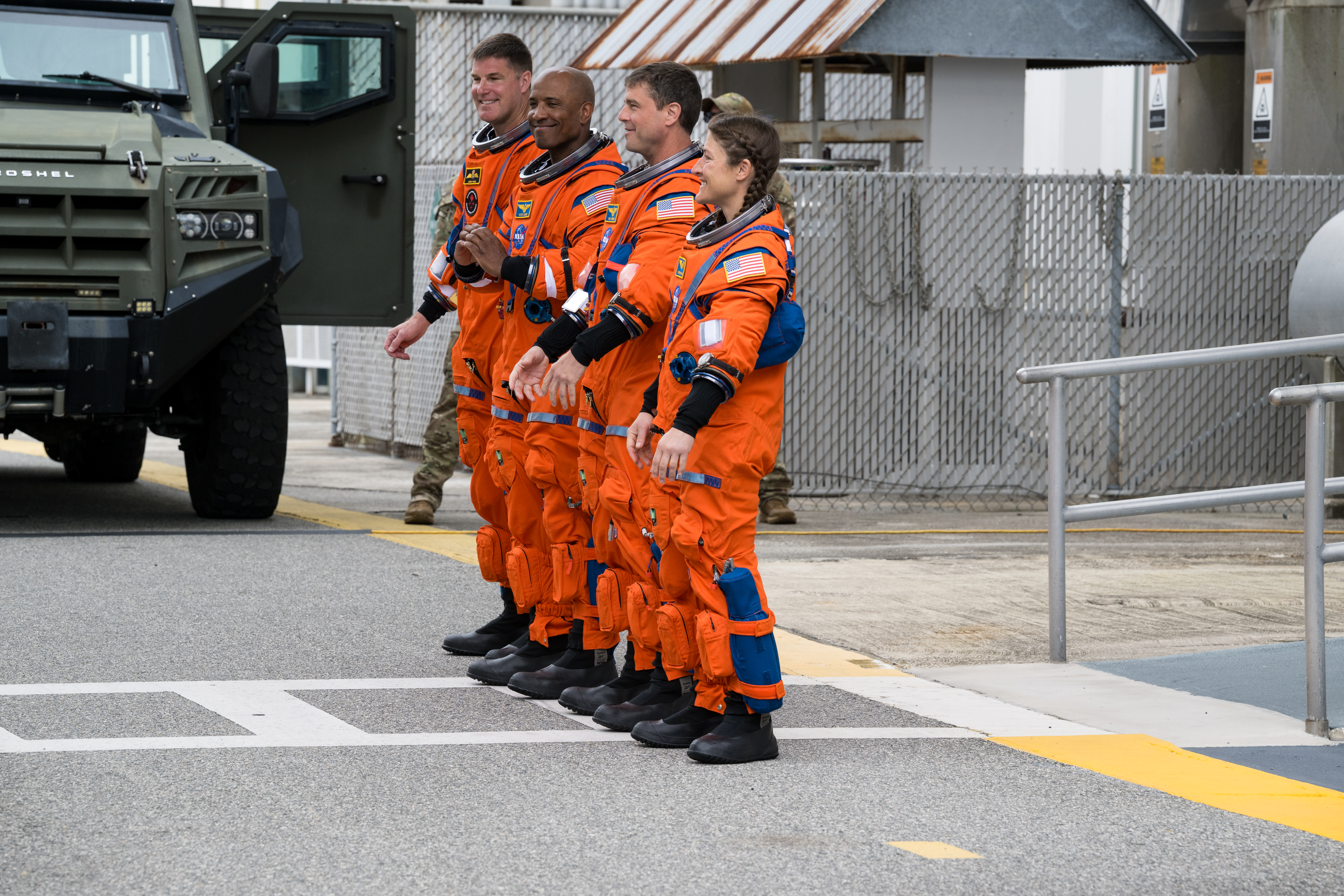
Before leaving Earth, the four Artemis II astronauts were suited up in their bright orange launch and entry suits — bulky, pressurised, and about as flattering as a suit of armour. Unable to see themselves, they relied entirely on the reassurance of their suit technicians and Mission Control. NASA captured the moment in a short film that quickly went viral: crew members being told, with deadpan sincerity, “Trust us, you look amazing.”
The clip resonated far beyond the space community. Covered by the BBC and shared widely on social media, it offered a rare and genuinely funny glimpse into the very human side of one of the most technically demanding missions in a generation. Commander Reid Wiseman, Pilot Victor Glover, Mission Specialist Christina Koch, and Mission Specialist Jeremy Hansen all took the gentle teasing in stride — a testament to the tight-knit bond the crew has built over years of training together.
The orange suits themselves are no joke: NASA's Orion Crew Survival System suits are custom-fitted to each astronaut and designed to keep them alive in the event of a cabin depressurisation or water landing. They integrate directly with Orion's seats and life-support umbilicals, and must be donned correctly every time — a process that takes a team of suit technicians and cannot be rushed. The humour of the video lands precisely because the stakes underneath it are so high.
It is a tradition as old as spaceflight itself — astronauts cracking jokes on the way to the pad, families waving through glass, technicians offering thumbs-ups through helmet visors. Moments like these remind the world that the people flying to the Moon are not just mission parameters and callsigns. They are human beings, dressed in impossible suits, trusting each other completely.
The Artemis II mission lasted 9 days, 1 hour and 32 minutes from launch to splashdown. The crew spent their first day in a 23.5-hour high Earth orbit checking out Orion, fired the service module’s main engine for trans-lunar injection on April 2, coasted to the Moon for four days, flew 4,067 miles above the lunar far side on April 6, then spent four days returning to Earth before splashing down in the Pacific Ocean off San Diego on April 10.
No, Artemis II did not land on the Moon. It was a crewed lunar flyby — the first time humans have traveled to the Moon's vicinity since Apollo 17 in 1972, but with no landing.
The mission used a free-return figure-eight trajectory: after leaving Earth orbit, Orion coasted to the Moon, swung around its far side at a closest approach of 4,067 miles (6,545 km), and let lunar gravity curve the spacecraft back toward Earth — no major engine burn required for the return, only small correction burns. This "free-return" design means the crew can get home safely even if propulsion fails, making it one of the safest possible paths through cislunar space.
Next, Artemis III (2027) will test rendezvous and docking with commercial lunar landers from SpaceX and/or Blue Origin in low Earth orbit; the first Artemis landing is now planned for Artemis IV in 2028. Artemis II's job was to stress-test every crewed system — life support, navigation, communications, re-entry — in the real deep-space environment before anyone tries to touch down on the lunar surface.
Unlike the ISS — where a crew can shelter in place while engineers on the ground take weeks to plan a repair — the Artemis II crew were days away from Earth, flying inside a capsule with 330 cubic feet of habitable volume — about as much living space as two minivans. Their options depend heavily on what breaks.
Software and avionics: Orion has two vehicle management computers, each made of two flight control modules — four in total — that continually cross-check one another. A module that hits a fault can “fail silent”, reset, relearn the spacecraft’s state from the others and rejoin within 22 seconds. A completely separate computer runs dissimilar backup flight software focused on crew survival and getting home.
Life support: Water, oxygen and nitrogen come from tanks in the European Service Module rather than recycling systems. If the cabin loses pressure, the crew can suit up: plugged into Orion’s umbilicals for air and CO₂ removal, their OCSS launch/entry suits can keep them alive for up to six days.
Propulsion: The European Service Module carries 33 engines in total: one main engine, eight auxiliary engines that can back it up, and 24 reaction-control thrusters for attitude. On Artemis II the main engine fired once, for the trans-lunar injection burn; smaller correction burns handled the rest. The free-return trajectory is the ultimate backstop — if all propulsion is lost after trans-lunar injection, the Moon's gravity still brings the crew home.
What they cannot fix: Artemis II deliberately avoids the complexity of a landing, in part because deep-space repairs have hard limits. There was no spacewalk — Orion has no airlock, and the crew's suits are launch/entry suits, not EVA suits. Structural damage to the heat shield, a ruptured propellant line, or a dead battery module are scenarios where the crew would rely on abort procedures and ground-coordinated contingency trajectories rather than hands-on repair.
Ground support: Mission Control at Johnson Space Center monitors thousands of telemetry channels in real time. At the Moon's distance, radio signals take about 1.3 seconds each way — fast enough for near-real-time voice coordination. Flight controllers uplinked burn plans and troubleshooting steps throughout the flight — for example when crew and ground worked through the toilet fault light on the first day. That continuous link to Earth is one of the most important repair tools the crew has.
Orion is NASA's deep-space crew vehicle designed to carry astronauts beyond low Earth orbit. The Artemis II Orion capsule is named "Integrity" by its crew and is designed to support 4 astronauts for up to 21 days. Built by Lockheed Martin, it uses a European Service Module (built by Airbus for ESA) that provides propulsion, power via solar arrays, and life support. Its AVCOAT heat shield — the largest of its kind at 16.5 feet in diameter — protected the crew during re-entry at about 35 times the speed of sound. Orion flew a steeper, non-skip entry, and NASA’s first inspection found the Artemis I char-loss problem “significantly reduced”.
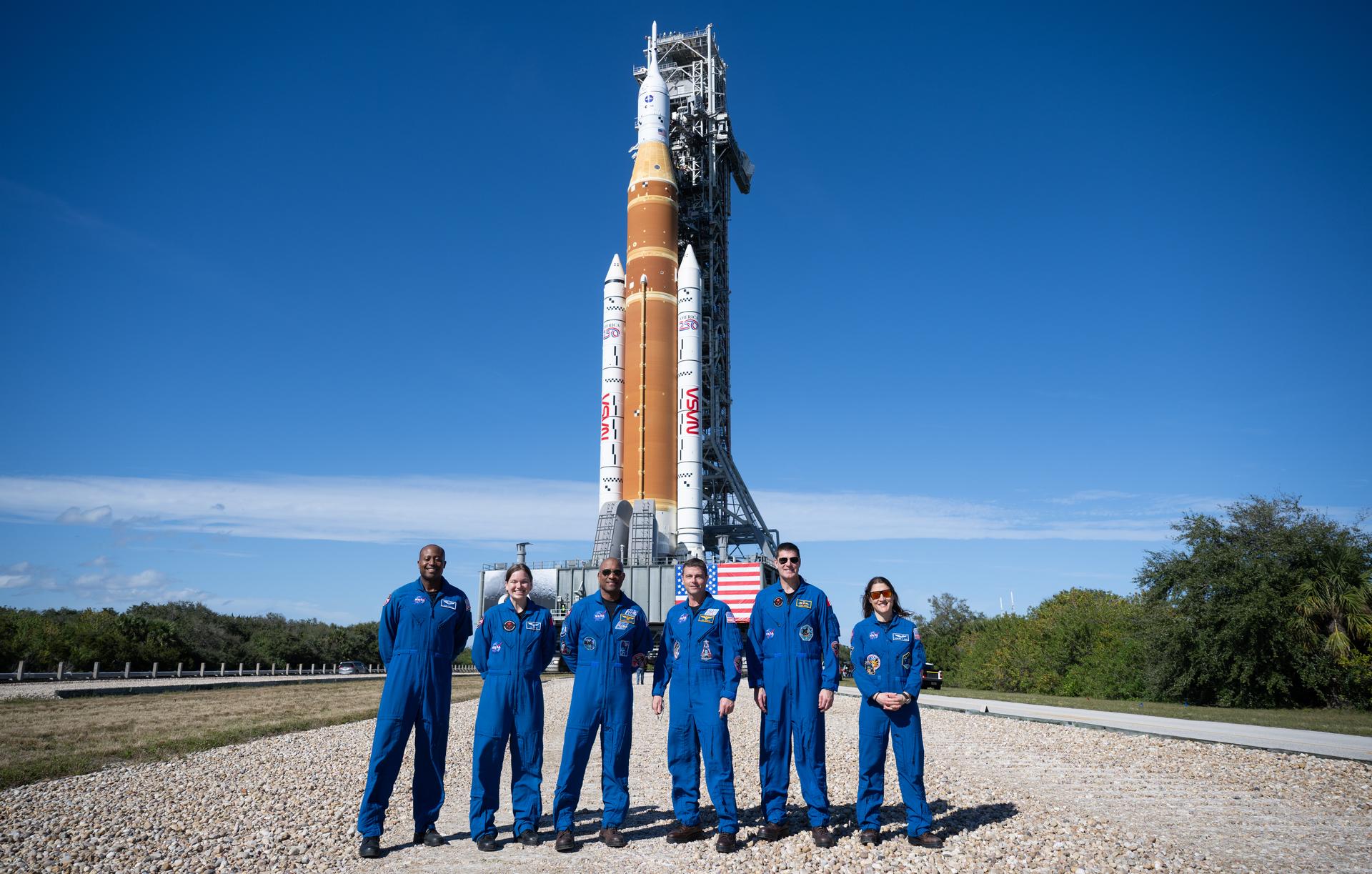
The Space Launch System is NASA's super-heavy-lift rocket and the most powerful rocket ever to carry a crew. The SLS Block 1 configuration used for Artemis II stands 322 feet tall, generates 8.8 million pounds of thrust at liftoff (15% more than the Saturn V), weighs 5.75 million pounds fueled, and can send more than 27 metric tons to the Moon. It uses four RS-25 engines (upgraded Space Shuttle main engines) and two five-segment solid rocket boosters.
On April 6, 2026 at 7:02 p.m. EDT, Orion reached 252,756 miles (406,771 km) from Earth while swinging behind the Moon’s far side. That broke the record set by Apollo 13 in 1970 for the farthest distance traveled from Earth by humans — 248,655 miles (400,171 km) — by about 4,100 miles; the crew passed the old mark at 1:56 p.m. that afternoon. Over the whole mission NASA says Orion covered roughly 694,000 miles (about 1.1 million km).
A free-return trajectory is a flight path that uses the Moon's gravity to naturally swing the spacecraft back toward Earth without requiring additional engine burns. If the spacecraft's propulsion system fails after trans-lunar injection, the crew will still safely return to Earth — the Moon's gravitational pull acts as a natural slingshot. This was the same type of trajectory used by Apollo 13 after its oxygen tank explosion in 1970, which saved the crew's lives.
Artemis II uses three distinct propulsion systems, each with its own fuel chemistry and management approach.
SLS Core Stage — Cryogenic LH2/LOX: The Space Launch System's four RS-25 engines burn liquid hydrogen (LH2) and liquid oxygen (LOX) — kept at −253 °C and −183 °C respectively. These cryogenic propellants are consumed entirely during the 8-minute ascent to orbit. The core stage holds 733,000 gallons of propellant, and its four engines provide about 2 million lbs of thrust. The two five-segment solid rocket boosters each produce up to 3.6 million lbs of thrust and separated just over two minutes into the Artemis II flight (T+2:09).
ICPS — Orbit Raising: The Interim Cryogenic Propulsion Stage (a modified Delta IV upper stage with a single RL10 engine) also burns LH2/LOX. On Artemis II it performed the perigee raise and then the apogee raise burn that placed Orion in a high Earth orbit reaching about 44,000 miles (70,000 km). After separating, the spent stage served as the target for the crew’s proximity operations demo. Unlike on the uncrewed Artemis I, the ICPS did not perform trans-lunar injection — Orion did that itself a day later.
Orion European Service Module — Hypergolic Propellants: Once in deep space, Orion relies on its European Service Module (ESM), built by ESA/Airbus. The ESM uses hypergolic propellants — monomethylhydrazine (MMH) and nitrogen tetroxide (NTO) — which ignite spontaneously on contact with each other, requiring no ignition system. This makes them extremely reliable for the manoeuvres required in deep space where a failed ignition could be fatal. The ESM carries 8.6 tonnes of propellant for its main engine, 8 auxiliary engines and 24 thrusters. On Artemis II the main engine performed the 5-minute-50-second trans-lunar injection burn, using about 1,000 lbs of propellant; smaller burns handled the course corrections out and back.
Fuel in Microgravity — The PMD Problem: In the weightlessness of space, liquid propellant doesn't settle to the bottom of a tank — it floats in blobs wherever surface tension pulls it. To guarantee fuel reaches the engine outlet at the right moment, Orion's tanks use Propellant Management Devices (PMDs): metallic vanes, sponge-like screens, and bladder diaphragms that exploit surface tension to continuously wick fuel toward the outlet regardless of orientation or acceleration. Before each burn, attitude thrusters perform a brief "settling burn" to nudge propellant toward the outlet using mild acceleration — a technique used since the Apollo era.
Power and Thermal Management: The ESM's four solar array wings generate about 11.2 kilowatts of electrical power and also regulate the spacecraft's temperature. Cryogenic stages require active insulation and venting of boil-off gases to prevent pressure build-up. The ICPS finished its work within the first hours of flight, while Orion’s storable hypergolic propellants handled trans-lunar injection a day later.
Unlike astronauts on the International Space Station who are partially shielded by Earth's magnetic field, the Artemis II crew traveled beyond this protective magnetosphere into deep space, where they were exposed to solar radiation. Solar flares and coronal mass ejections (CMEs) can produce dangerous radiation bursts. NASA and NOAA monitored space weather around the clock during the mission, and the crew could shelter in the most shielded areas of Orion if a solar event occurred. Radiation sensors at different shielding locations in the cabin and dosimeters worn by the crew recorded their exposure, and three of the four CubeSats deployed after launch were built to study radiation or space weather.
NASA covered the April 1, 2026 launch live on NASA+, NASA’s website and YouTube, with coverage starting hours before liftoff, including crew suit-up and the trip to the pad. For the return on April 10, live coverage began at 6:30 p.m. EDT on NASA+, Amazon Prime, Apple TV, Netflix, HBO Max, Discovery+, Peacock and Roku. Replays remain on NASA+ and NASA’s YouTube channel — the full splashdown broadcast is embedded near the top of this page, and this archive keeps the trajectory, timeline and flight-day log in one place.
The Artemis II crew eat specially packaged NASA space food developed at the Johnson Space Center's Space Food Systems Laboratory — 189 unique menu items, including 10 beverages such as coffee and smoothies. Most meals are either thermostabilized (heat-treated and sealed to be shelf-stable), freeze-dried (rehydrated with the Orion water dispenser before eating), or ready-to-eat items like nuts, granola bars and tortillas. Bread is avoided entirely — crumbs floating in microgravity can clog equipment or be inhaled.
Orion has a water dispenser and a food warmer, but the warmer’s capacity is limited, so the crew expected to eat much of their food at room temperature. The menu included tortillas, nuts, barbecue beef brisket, macaroni and cheese, cauliflower, butternut squash, cookies and chocolate. Drinks are mixed in sealed pouches and sipped through straws.
Unlike long-duration ISS missions, Artemis II's nine-day flight meant the crew did not need resupply or to grow food — the full supply is carried at launch. NASA's Human Research Program studies how nutrition, taste perception, and appetite change during deep-space missions beyond the protection of Earth's magnetosphere.
Sleeping in space presents unique challenges: without gravity there is no “up” or “down”, and Orion has no private crew quarters like the ISS. The Artemis II crew used lightweight sleeping bags attached to Orion’s walls and ceiling — NASA compares them to four stretched hammocks across the cabin — and for most of the mission all four slept at the same time.
The schedule set aside eight hours of sleep each day (except the first day), synchronized with Mission Control in Houston. The ARCHeR study (Artemis Research for Crew Health and Readiness) had the crew wear watch-like actigraphy monitors before, during and after the flight to track sleep, activity and how they performed individually and as a team.
Yes — for the first time in history, NASA crew members carried personal smartphones beyond Earth's orbit. On February 5, 2026, NASA Administrator Jared Isaacman announced that astronauts on Crew-12 (to the ISS) and Artemis II could carry personal iPhones, marking a significant shift from NASA's traditionally strict no-personal-devices policy for crewed spacecraft. The Artemis II crew took theirs around the Moon — the first personal smartphones to travel beyond Earth orbit.
The purpose is twofold: mission documentation and public engagement. In Isaacman's own words: "We are giving our crews the tools to capture special moments for their families and share inspiring images and video with the world." The iPhone's high-resolution camera system allows the crew to shoot personal photos and behind-the-scenes video footage that official NASA cameras would not typically capture — informal moments, zero-gravity floating objects, Earth and Moon views through the windows.
The crew were filmed throwing an iPhone around in zero gravity shortly after reaching orbit, a lighthearted moment that went viral. The clip showed the phone drifting weightlessly through Orion's cabin — a sharp contrast to the serious engineering imagery typically associated with NASA missions.
The phones joined an unusually large camera kit: NASA says Orion carried 32 cameras and devices able to capture photos or video — 15 mounted on the spacecraft and 17 handheld cameras operated by the crew. Together the crew captured more than 7,000 images of the lunar surface alone.
Crew-12 astronauts on the ISS received the same permission, but only the Artemis II crew took their phones more than 400,000 km from Earth.
Orion is equipped with the Universal Waste Management System (UWMS) — a compact space toilet about 60% smaller than the Space Shuttle’s, at roughly 5 cubic feet. Since liquids and solids float freely in weightlessness, it uses airflow rather than gravity and collects urine and feces separately, with a seat and funnel redesigned to work better for female astronauts. Pre-treated urine (treated to stop ammonia forming) is stored in a tank and vented overboard; feces are collected in a can and stowed for disposal after landing.
The toilet sits in a small hygiene bay with doors for privacy. Hygiene is maintained with baby wipes, liquid soap with a little water on a washcloth, and no-rinse shampoo, as there is no shower. Oral hygiene uses a standard toothbrush; toothpaste is swallowed or spat into a towel to prevent droplets from floating around the cabin. The toilet fault light on April 1, 2026 — resolved by the crew with Mission Control — showed just how critical this system is, and NASA later named a urine vent line problem as the one item to root-cause before Artemis III.
Prolonged weightlessness causes the human body to rapidly deteriorate: muscles shrink because they no longer need to work against gravity, bones lose density at roughly 1–1.5% per month, and the cardiovascular system weakens as the heart no longer needs to pump blood upward against gravity. On the ISS, astronauts exercise about two hours a day to counteract this. At just over nine days, Artemis II's duration is short enough that significant muscle or bone loss is not a major concern, but the crew still worked out for about 30 minutes nearly every day on Orion’s flywheel — a 30-lb device mounted below the side hatch that provides up to 400 lbs of resistance for rowing, squats and deadlifts.
NASA's Human Research Program collects health data before, during and after the mission to understand how the body responds to deep-space conditions — particularly radiation exposure beyond Earth's magnetic field, which is unique to Artemis II compared to ISS missions. Crew members wear personal radiation dosimeters throughout the flight and blood, urine and saliva samples collected in orbit are returned to Earth for analysis. Vision changes caused by intracranial pressure shifts in microgravity — a condition known as SANS (Spaceflight-Associated Neuro-ocular Syndrome) — are also monitored closely. Other Artemis II studies included AVATAR (organ chips grown from the crew’s own cells, flown outside the Van Allen belts for the first time), Immune Biomarkers (saliva samples) and the Artemis II Standard Measures.
Artemis II relied on NASA's Space Communications and Navigation (SCaN) network — a global system of ground stations and relay satellites that maintain contact with spacecraft throughout the solar system. At lunar distances, radio signals travel at the speed of light and take approximately 1.2–1.3 seconds one-way — meaning a round-trip conversation has a natural ~2.6-second delay, barely noticeable but present. This is vastly different from future Mars missions where communication delays of 4–24 minutes one-way would make real-time conversation impossible.
Near Earth, Orion talked through the Near Space Network and its TDRS relay satellites; farther out it used the Deep Space Network (DSN) — NASA's worldwide array of large antenna dishes located in California (Goldstone), Spain (Madrid) and Australia (Canberra). Artemis II also flew the O2O laser communications terminal, which beamed data to ground stations in California and New Mexico at up to 260 megabits per second and passed 100 gigabytes downlinked by Flight Day 4. Everything was routed to Mission Control at Johnson Space Center in Houston, Texas, where flight controllers monitored the spacecraft 24/7. On April 7 the crew even made a 15-minute ship-to-ship call to the International Space Station.
The Artemis II crew wore different suits depending on the phase of the mission. During launch, re-entry and other high-risk phases, each astronaut wore the Orion Crew Survival System (OCSS) suit — an orange pressure suit made by David Clark Company and custom-fitted to each astronaut. It can keep an astronaut alive for up to six days if the cabin depressurizes, and provides fire resistance, integrated communications, and a flotation collar for ocean recovery. It is not designed for spacewalking.
For the majority of the mission in cruise phase, the crew wore lightweight in-cabin flight suits or personal clothing — comfortable layers suited to Orion's temperature-controlled cabin. NASA worked with the crew on personal preference items they could bring: each astronaut is allocated a small allowance of personal items, from family photos to favourite snacks.
Looking ahead, NASA's Axiom Space is developing the AxEMU (Axiom Extravehicular Mobility Unit) — the next-generation spacewalking suit planned for lunar surface operations, which NASA now expects to begin with Artemis IV. Artemis II did not include any spacewalks (EVAs), so no EVA suit was carried.